• Pilot 2 plaza ,Charles Rubia lane

busta refrigeration

Cold Room Expansion Valves in Kenya

If you’re in the business of food storage, pharmaceuticals, or any industry reliant on precise temperature control, you know that a cold room is more than just an insulated space—it’s a complex mechanical system. At the heart of this system lies a component so critical that its failure can bring your entire operation to a halt: the expansion valve.

Often overlooked, the expansion valve is the precision metering device of your refrigeration cycle. Choosing the right one, understanding its function, and maintaining it properly are what separate a highly efficient, reliable cold room from a problematic, energy-guzzling one.

In this comprehensive guide, we’ll demystify the cold room expansion valve for business owners, technicians, and procurement managers across Kenya.
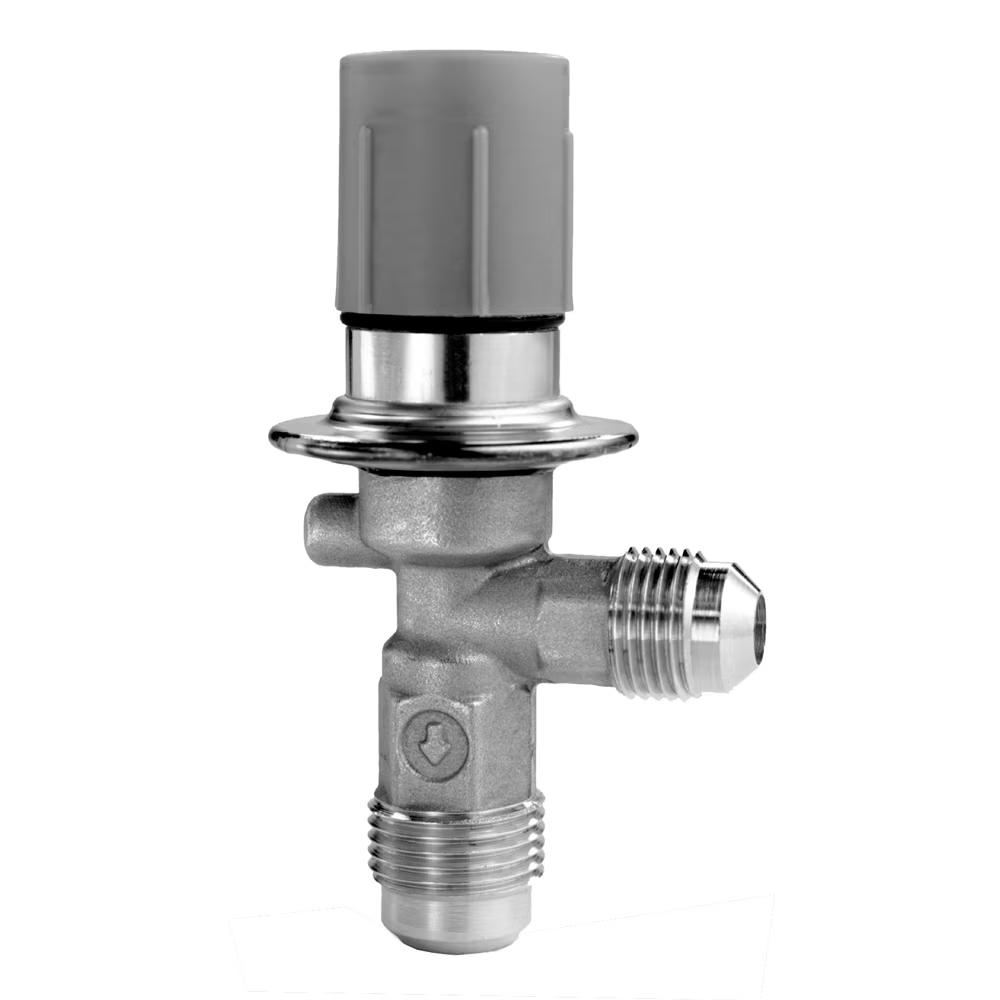
Thermostatic Expansion Valves

What is a Cold Room Expansion Valve and Why is it So Crucial?


Imagine the refrigerant in your system as the lifeblood of your cold room. The expansion valve acts as the precise control gate between the high-pressure, high-temperature liquid refrigerant coming from the condenser and the low-pressure evaporator where the actual cooling happens.

Its primary functions are:

Pressure Reduction: It creates a significant pressure drop, causing the high-pressure liquid refrigerant to rapidly expand.

Flow Regulation: It meticulously meters the exact amount of refrigerant flowing into the evaporator coils.

Superheat Control: This is its most important job. The valve ensures that the refrigerant completely evaporates by the time it leaves the evaporator, protecting your compressor from potentially catastrophic liquid slugging.

In short, a properly functioning expansion valve ensures:

Maximum Energy Efficiency: The right amount of refrigerant is always in the evaporator, absorbing heat optimally.

Stable Temperature Control: It maintains consistent superheat, which translates to a stable and precise cold room temperature.

Compressor Protection: By preventing liquid refrigerant from returning to the compressor, it safeguards the most expensive component in your system.

A Deep Dive into the Types of Expansion Valves

Not all expansion valves are created equal. The right choice depends on your application, load variability, and budget. Here are the main types you’ll encounter in the Kenyan market.

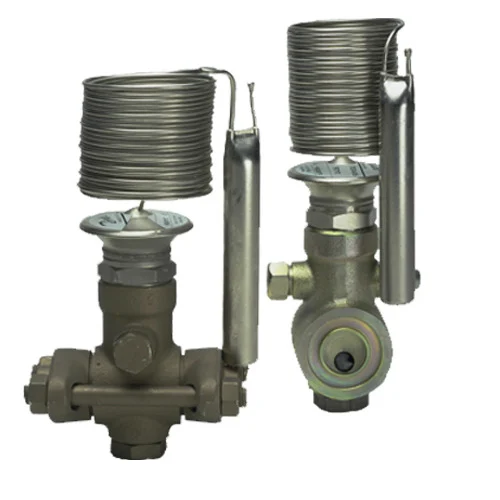
1. Thermostatic Expansion Valve (TXV or TEV)

The TXV is the industry workhorse and the most common type found in commercial and industrial cold rooms.

How it Works: It uses a sensing bulb filled with a charge (gas or liquid) that is clamped to the evaporator outlet. This bulb senses the temperature of the suction line. The pressure from this bulb (P1) acts on one side of a diaphragm, opposing the evaporator pressure (P2) and a spring pressure (P3). The valve modulates open or closed based on the balance of these three forces to maintain a constant superheat.

Best For: Applications with varying loads, such as cold rooms with frequent door openings, blast freezers, and chillers. They offer excellent efficiency under fluctuating conditions.

Our Range: We stock a wide variety of TXVs with interchangeable orifices (e.g., TE5, TE12, TX2, TEX2) to match your specific refrigerant (R404A, R134a, R22, etc.) and cooling capacity.

Thermostatic Expansion Valve (TXV or TEV)
 
2. Electronic Expansion Valve (EEV or EXV)

The EEV represents the pinnacle of precision control in modern refrigeration.

How it Works: Instead of relying on mechanical forces, an EEV uses a stepper motor to open and close the valve port. It receives signals from electronic temperature and pressure sensors, which are processed by a dedicated controller. This allows for incredibly precise and rapid adjustments.

Best For: Highly sophisticated systems where precision is paramount (e.g., pharmaceutical storage, laboratory cold rooms, and complex cascade systems). They integrate seamlessly with modern PLC controls for optimal performance.

Advantage: Superior efficiency, especially under part-load conditions, and excellent stability.

2. Electronic Expansion Valve (EEV or EXV)
 
3. Automatic Expansion Valve (AXV)

The AXV is a simpler, older technology.

How it Works: It operates solely on evaporator pressure (P2). It aims to maintain a constant pressure in the evaporator, not a constant superheat.

Best For: Systems with very stable, constant loads. Its performance drops significantly with load variations, as it cannot respond to changes in heat load like a TXV can.

Consideration: While cost-effective, it is generally less efficient for most cold room applications where load is not perfectly constant.

Automatic Expansion Valve (AXV)
4. Capillary Tube

The capillary tube is the simplest and most cost-effective “metering device.”

How it Works: It’s a long, narrow tube of fixed diameter and length that provides a fixed restriction. It does not actively regulate flow.

Best For: Small, sealed, pre-charged systems with a constant load, like some domestic refrigerators, small beverage coolers, or pre-fabricated units.

Consideration: It offers no protection against compressor floodback under varying loads. It is not serviceable and is matched to a specific refrigerant charge.

Capillary Tube

Choosing the Right Expansion Valve for Your Cold Room in Kenya

Selecting the wrong valve can lead to inefficiency, frequent breakdowns, and spoiled inventory. Here are the key factors our technicians at The Cold Room Kenya consider:

  1. Refrigerant Type: The valve must be specifically designed for the refrigerant you are using (e.g., R404A, R134a, R507, NH3 for larger systems).

  2. Cooling Capacity (in Tons of Refrigeration or kW): The valve must be sized correctly for your system’s capacity. An oversized valve will hunt (cycle open and closed rapidly), while an undersized valve will starve the evaporator.

  3. Operating Temperatures: A valve for a -25°C freezer will have a different internal charge and design than one for a +2°C chiller.

  4. Load Variability: Do you have a steady load, or does it fluctuate with door traffic and product loading? This is the primary deciding factor between a TXV and an AXV.

  5. Evaporator Design: The valve must be compatible with the evaporator’s design and its required pressure drop.

Common Signs of a Failing Expansion Valve

How do you know your expansion valve needs attention or replacement? Look for these symptoms:

  • Fluctuating Temperatures: Inability to maintain a set point.

  • High Superheat: Indicates the valve is starving the evaporator. The suction line will feel warm, and cooling capacity will be severely reduced.

  • Low/No Superheat (Flooding): Indicates the valve is stuck open, allowing too much refrigerant. This can cause liquid floodback to the compressor, leading to damage.

  • Hunting: A cyclical fluctuation in suction pressure and temperature caused by the valve constantly over-correcting.

  • Frosting or Icing: Uneven frosting on the evaporator coils or on the valve itself can indicate a blockage or malfunction.


Pro Tip: Diagnosing a faulty expansion valve should always be done by a qualified refrigeration engineer. Symptoms like low cooling can also be caused by a dirty coil, low refrigerant charge, or a failing compressor.

Why Source Your Cold Room Expansion Valves from The Cold Room Kenya?


In a market flooded with counterfeit and substandard parts, quality is not a luxury—it’s a necessity.

Genuine Parts: We supply only original, high-quality expansion valves from reputable manufacturers, ensuring reliability and longevity.

Technical Expertise: We are not just sellers; we are refrigeration specialists. We can help you select the perfect valve (TXV, EEV, etc.) with the correct orifice for your specific application.

Nationwide Support: Wherever you are in Kenya, from Mombasa to Kisumu, Nairobi to Nakuru, we can get you the parts and technical support you need.

Complete System View: We understand how the valve interacts with the compressor, condenser, and evaporator, allowing us to provide holistic solutions, not just parts.

Conclusion: Don’t Let a Small Valve Cause a Big Problem

The cold room expansion valve may be a small component, but its role is monumental. Proper selection, installation, and maintenance are non-negotiable for the health of your refrigeration system and the protection of your valuable stored goods.

Is your cold room running inefficiently? Are you experiencing temperature fluctuations? It might be time to inspect your expansion valve.

Contact The Busta Refrigeration today. Let our experts provide you with the right OEM expansion valve and the technical guidance to keep your business running cool and profitable.

Browse our catalog or call us for a consultation on the best expansion valve solution for your needs.